
In short
- Reclaim automatically schedules time in your calendar for tasks, habits and focus, and protects that time when meetings come in. That's what Reclaim is good at, for teams too.
- Dowit is a work planner for freelancers: your calendar, tasks, projects and hours per client in one place, with what's left to invoice each month.
- Both work with AI. The difference: Reclaim schedules on its own, Dowit plans when you ask, and tracks your hours per client for invoicing.
- Both have a free plan. Reclaim's schedules up to a week ahead; Dowit's is for up to 3 clients.
Reclaim is a well-known AI planner for Google Calendar and Outlook. You enter your tasks, your habits (like an hour of exercise or a lunch break) and your focus time, and Reclaim finds room for them in your calendar. When a meeting comes in, Reclaim moves your blocks.
Freelancers still often look for something else. They want to decide for themselves what happens today, or they need to track hours per client and invoice next to their planning. This guide puts Reclaim and Dowit side by side, honestly.
What's the difference between Reclaim and Dowit?
Reclaim fills your calendar automatically with blocks for your tasks, habits and focus, and schedules meetings through scheduling links.
Dowit is a work planner for freelancers and small agencies. You plan your day and week with your calendar and a focus of a few tasks, your tasks and hours belong to clients and projects, and each month you see what to invoice. You run it in the app or with Claude or ChatGPT: "block two hours tomorrow for the Acme proposal", "1h Acme, 30m Northwind", "what do I still need to invoice?".
| Reclaim | Dowit | |
|---|---|---|
| Schedule tasks in your calendar | Automatically, by Reclaim | When you ask, by Claude or ChatGPT, or yourself |
| Protect habits and focus time | Yes | No |
| Scheduling links for meetings | Yes | No |
| Calendar | Google Calendar and Outlook | Google Calendar, both ways |
| Tracking time | Stats on how your calendar time is spent | Hours per client and project, with a timer or afterwards in one sentence |
| Invoicing report per client | Not mentioned | Yes, in Pro: per client and month, with amounts |
| AI and Claude | Claude (MCP) and ChatGPT integrations mentioned on the site | Yes, through MCP, and listed in the Claude connector directory |
| Free plan | Yes, Lite: 1 user, schedules up to 1 week ahead, 2 calendars | Yes, up to 3 clients |
| Paid plan | Starter $10 per user per month billed yearly ($12 monthly), Business $15 ($18) | $10 per user per month, or $100 per year (€9 / €90 excl. VAT in Europe) |
Reclaim details from their pricing page on 12 November 2026. Check current plans and prices at reclaim.ai.
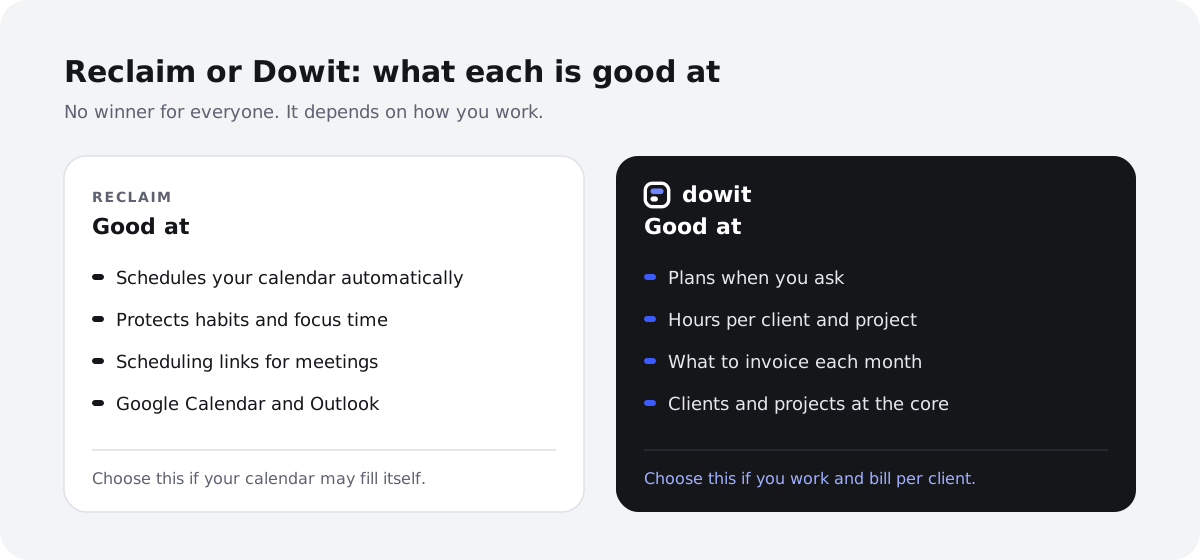
Where is Reclaim better?
- Fully automatic scheduling. Reclaim finds time for your tasks itself and moves them when your calendar changes. Dowit plans when you ask, not on its own in the background.
- Habits and focus time. Reclaim protects fixed moments, like focus time or a lunch break, even when others want to book meetings.
- Scheduling links and teams. Reclaim has links for others to book time with you, and schedules meetings for teams.
- Outlook and integrations. Reclaim works with Outlook and with task apps like Todoist, Asana, ClickUp, Jira and Linear.
Where is Dowit different?
You decide, your AI does it
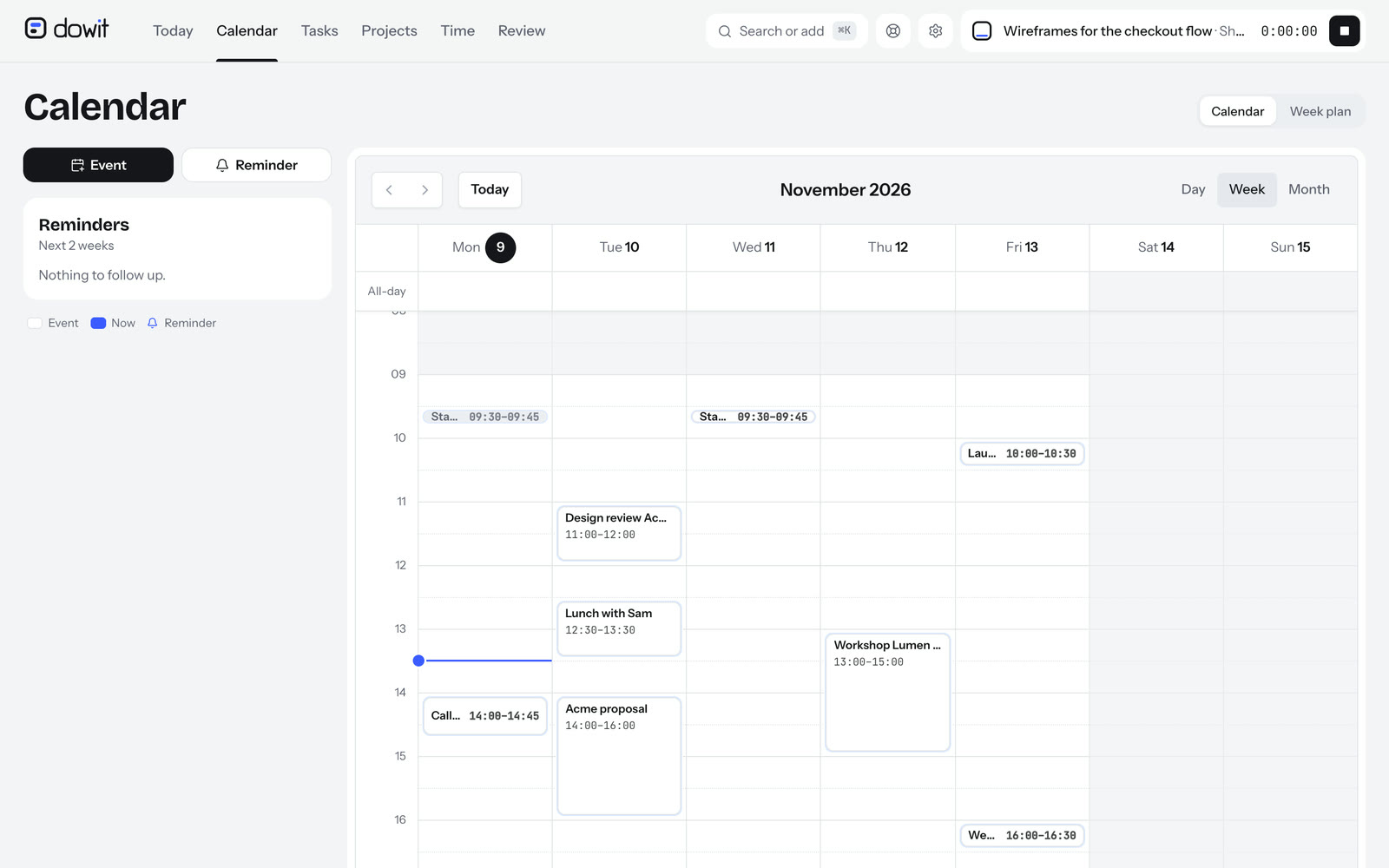
In Dowit, your AI doesn't schedule anything you didn't ask for. You say what you want, your AI finds free time between your events and puts it in your calendar. So you always know why something is there. Every day you choose a few focus tasks; what you don't finish, you move to tomorrow with one click.
Hours per client, for invoicing
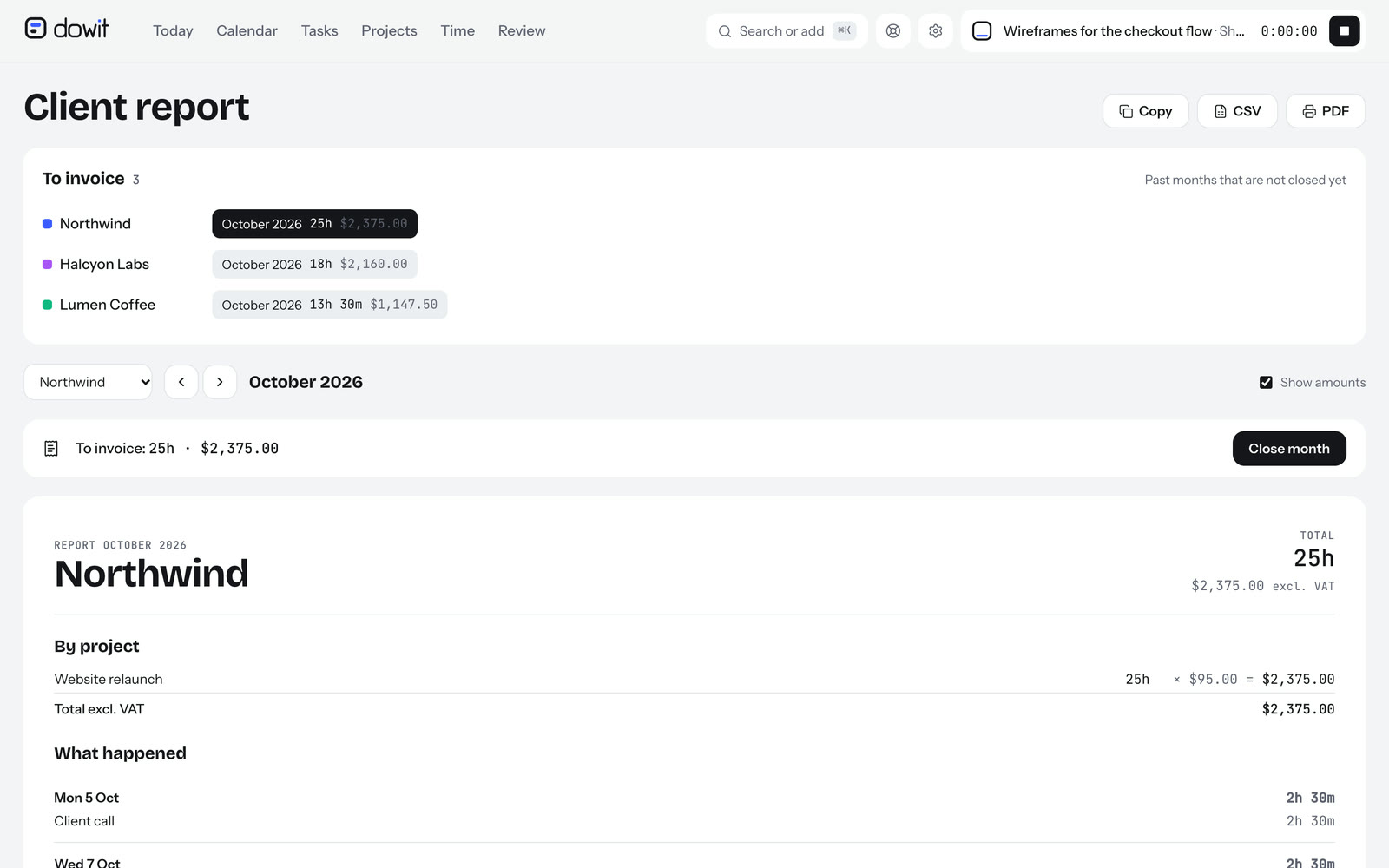
Reclaim shows how your time is spread over meetings, tasks and habits. Dowit tracks your hours per client and per project, with a timer or afterwards in one sentence ("1h Acme, 30m Northwind"), with hourly rates per client or project. At the end of the month you see per client what to invoice, as a report, PDF, CSV or Excel for your own invoicing tool.
Clients and projects at the core
In Dowit, your tasks, events and hours belong to a client and a project. So you don't just see when you work, but also for whom, and how much time each client takes.
What does it cost?
- Reclaim: a free plan (Lite) for 1 user, which schedules up to a week ahead. Starter costs $10 per user per month billed yearly (or $12 monthly), Business $15 (or $18). See reclaim.ai/pricing.
- Dowit: free for up to 3 clients. Pro costs $10 per user per month (or $100 per year); in Europe €9 (or €90 per year) excl. VAT, with your first 14 days free. See pricing.
How do you switch from Reclaim to Dowit?
- Create an account at dowit.io and connect your Google Calendar under Settings → Calendar. Your events show up in Dowit right away.
- Create your clients and projects, with your hourly rates, so your hours land with the right client right away.
- Move your open tasks. If they come from Todoist, import a CSV under Settings → Import. Or paste your list into a conversation with Claude or ChatGPT: "Put these tasks in Dowit, with the right client and their due date."
- Connect your AI under Settings → AI assistant and plan your week: "Plan my week: spread my open tasks over the days, due dates first."
Turn off Reclaim's automatic blocks before you switch, so they don't end up in your calendar twice.
Frequently asked questions
Does Dowit schedule my tasks automatically, like Reclaim?
Not on its own in the background. Dowit plans when you ask: you tell Claude or ChatGPT "plan my week" or "find two hours tomorrow for this", and your AI puts it in your calendar. So you stay in control.
Can I track my hours per client in Dowit?
Yes, on every plan: with a timer, or afterwards in one sentence to your AI. You see your hours per client, project or day, and with Pro what's left to invoice each month, with amounts.
Do I need Claude or ChatGPT?
Not necessarily. Dowit also works as a regular app, on your computer and phone. With your AI it's a lot faster, though.
Who is Reclaim a better choice for?
For people who want an app to fill and protect their calendar fully automatically, and for teams who plan meetings and focus time together.