
In short
- Hourly rate = (target annual income + business costs) ÷ billable hours per year.
- Billable hours per year = (52 − weeks off) × working hours per week × billable share.
- Be realistic about the billable share: for many freelancers it sits somewhere around 50–65% of their working hours.
- Example: $60,000 income + $10,000 costs ÷ 1,080 hours ≈ $64.81, rounded to $65 an hour excluding VAT or sales tax.
- Check the result against market rates, always quote excluding tax, and have an accountant look over your numbers.
Plenty of freelancers set their rate by feel: what a peer charges, what sounds reasonable, or what won't scare off a client on the first call. That works until the end of the year, when you realise you've been flat out and still haven't earned enough.
A sound hourly rate comes from a handful of simple numbers. The calculator above works it out in under a minute. This guide explains what each field means, how to fill it in with realistic figures, and what to do with the answer.
How do you calculate your freelance hourly rate?
It all comes down to one question: how much does every hour you can bill need to bring in, so that by the end of the year you've covered both your income and your costs?
Hourly rate = (target annual income + annual business costs) ÷ billable hours per year
Billable hours are worked out like this:
Billable hours per year = (52 − weeks you don't work) × working hours per week × billable share
If you want some headroom, multiply the result by (1 + buffer). A 10% buffer means × 1.10. Your day rate is your hourly rate × 8.
The calculator above runs exactly this sum. Let's go through its six fields one at a time.
Step 1: Decide on your target annual income before tax
This is what you want to take out of the business before income tax and social contributions. Think about what you need to live on, plus what you want to put aside. A salaried job is a useful reference point, but remember that as a freelancer you cover things an employer would otherwise handle, such as a pension or sick pay.
How much tax and how many contributions you then pay varies a great deal between countries and circumstances. Ask your accountant what pre-tax figure you need to end up with the take-home pay you're after.
Step 2: Add up your annual business costs
Everything your business costs has to be paid for out of your rate. Total it per year: monthly subscriptions × 12, and big purchases such as a laptop spread over the years you'll use them. There's a checklist further down so nothing slips through.
Step 3: Count the weeks you won't work
A year has 52 weeks, but you'll never work all of them. Take off your holidays, public holidays (which add up to a couple of weeks on their own) and an allowance for illness. In the example that's 7 weeks, leaving 45 working weeks. If you plan training weeks or a quiet summer, take those off too.
Step 4: Set your working hours per week and your billable share
Working hours per week means all the time you spend on the business, not just client work. The billable share is the percentage of that time you can actually charge to a client. It's the figure people most often fill in too optimistically, more on that below.
Step 5: Work out your rate and add a buffer if you want one
Divide the total (income + costs) by your billable hours. If you'd like room for setbacks, such as a client who pays late or a thin month, add a buffer. It's optional: leave it at 0% and the result is the minimum rate you need.
A worked example: from $60,000 to an hourly rate
These are the calculator's default values. They're purely illustrative; your own numbers depend on your circumstances, your country and your field. The maths is the same in any currency.
| Item | Example |
|---|---|
| Target annual income before tax | $60,000 |
| Annual business costs | $10,000 |
| Total you need to earn | $70,000 |
| Weeks you don't work | 7 → 45 working weeks |
| Working hours per week | 40 |
| Billable share | 60% → 24 billable hours a week |
| Billable hours per year (45 × 24) | 1,080 |
| Hourly rate (70,000 ÷ 1,080) | ≈ $64.81, rounded to $65 excl. tax |
| Day rate (8 hours) | ≈ $519 |
Add a 10% buffer and you land at roughly $71.30 an hour. Whether you need that buffer depends on how predictable your work is.
Notice how small 1,080 hours looks next to the 2,080 hours in 52 weeks of 40 hours. That gap is exactly why freelance rates sit well above what a salary works out to per hour.
Which costs should your hourly rate cover?
Any cost you forget comes out of your own pocket. Work through this list and put an annual figure against each item:
- Software and subscriptions: design or development tools, your planner and time tracking, cloud storage, your website and domain, your invoicing or accounting software.
- Equipment: laptop, monitor, phone and accessories, spread over their useful life.
- Insurance: professional indemnity or income protection, for example, depending on your field and where you live.
- Training: courses, books, conferences, certifications.
- Workspace: a coworking desk, or a share of rent and energy if you work from home, plus your internet connection.
- Accountant: the yearly cost of your tax return and advice.
- Pension and savings: not always a business cost in the accounting sense, but something you have to fund from your earnings without an employer. Include it in either your costs or your target income, not both.
- Everything else: marketing, travel, bank charges, professional memberships.
Which costs are tax-deductible varies by country. For working out your rate it doesn't matter: you count what you actually spend.
Why can you only bill part of your working hours?
A 40-hour week doesn't mean 40 hours of client work. A large share of your time goes on keeping the business running, and nobody pays for that directly:
- admin, invoicing and bookkeeping;
- finding new clients, networking and keeping your website up to date;
- writing proposals and taking introductory calls;
- learning new skills and trying out tools;
- emails and small requests you don't bill for.
That's why many freelancers end up billing roughly 50–65% of their working hours. If you're just starting out and still building a client base, it's often lower. With a few regular clients and ongoing work, it can be higher.
See how much that one percentage moves your rate, using the same $70,000 and 45 working weeks of 40 hours:
| Billable share | Billable hours per year | Hourly rate |
|---|---|---|
| 50% | 900 | ≈ $77.78 |
| 60% | 1,080 | ≈ $64.81 |
| 65% | 1,170 | ≈ $59.83 |
If in doubt, use the lower percentage. If you beat it in practice, that's a healthy margin; the other way round, you fall short. You'll find how to measure your real figure in the Dowit section below.
How do you check your rate against the market?
Your calculation tells you the minimum you need. The market tells you what clients are used to paying. Put the two side by side:
- Ask around among peers in your field and your area, or in a professional association or online community.
- Look at freelance marketplaces and job listings in your field, where rates are sometimes published.
- Factor in experience and specialism: a niche specialist can usually charge more than a generalist.
If your calculated rate is clearly below the going rate, you're probably leaving money on the table and can aim higher. If it's well above, first check whether your costs and billable share are realistic. If they are, consider specialising or targeting a different kind of client rather than working below your minimum.
Always quote excluding VAT or sales tax
Quote business clients your rate excluding VAT or sales tax, and say so explicitly: "$65 an hour excl. tax". The tax isn't yours; you collect it on the government's behalf. Which rules apply to you depends on your country, your work and your clients, so check with your accountant.
Hourly rate, day rate or fixed price: which should you use?
Your hourly rate is the foundation, even if it never appears on a proposal.
| Hourly rate | Day rate | Fixed price | |
|---|---|---|---|
| Suits | Variable, ongoing work | Jobs booked in whole days, often on site | Well-defined work with a clear deliverable |
| Example | $65 an hour | ≈ $519 a day (hourly rate × 8) | $5,200 for a website, estimated at 80 hours |
| Who carries the overrun risk | The client | Shared | You |
For a fixed price, multiply your estimated hours by your hourly rate and add a margin for uncertainty. Keep tracking your time anyway, so you can see afterwards whether your estimate held up. For more on choosing a model and on timesheets, read how to bill by the hour.
When and how should you raise your rate?
A rate isn't set in stone. Rerun the numbers in the calculator above at least once a year, and also when:
- your costs have gone up noticeably;
- you've built up more experience or a specialism;
- you're fully booked and turning work away;
- your billable share turns out lower than you assumed.
Use your new rate straight away for new clients. Give existing clients good notice, say one or two months, with a short explanation and a clear start date. The turn of the year or the start of a new project makes the change feel natural.
How does Dowit help you work with your hourly rate?
A rate only pays off if you actually bill every hour you work. Dowit is a work planner for freelancers where you track time alongside your tasks, calendar and projects.
- Hours per client and project: start a timer on a task, or afterwards send one sentence to your own AI (Claude or ChatGPT): "1h Acme, 30m Northwind". Dowit places the blocks one after another in your working day. Read more in how to track time with Claude or ChatGPT and on Dowit with your AI.
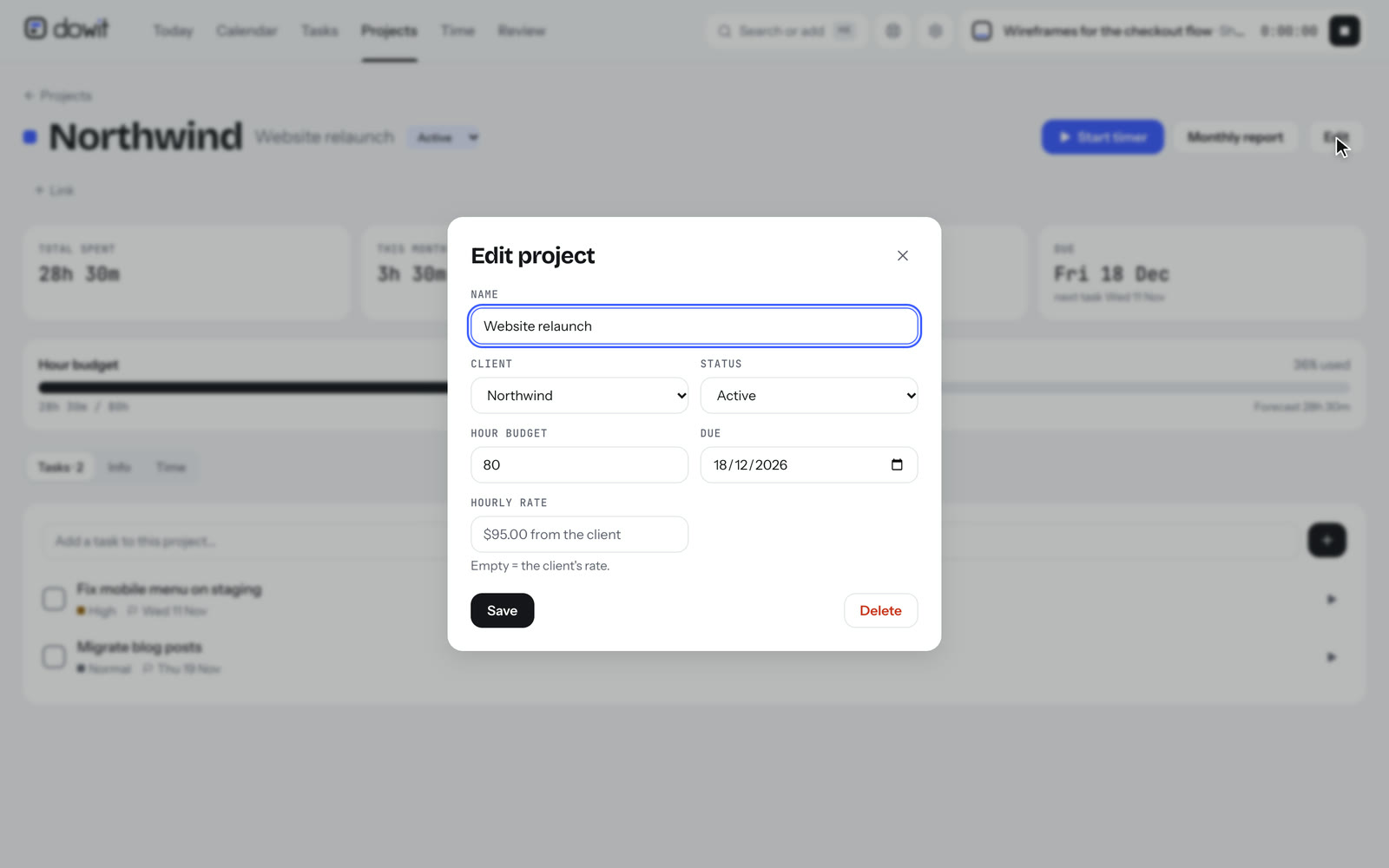
- An hourly rate per client or per project, in your workspace currency (dollars, pounds, euros and so on). Strategic advice for Acme can have a different rate from maintenance.
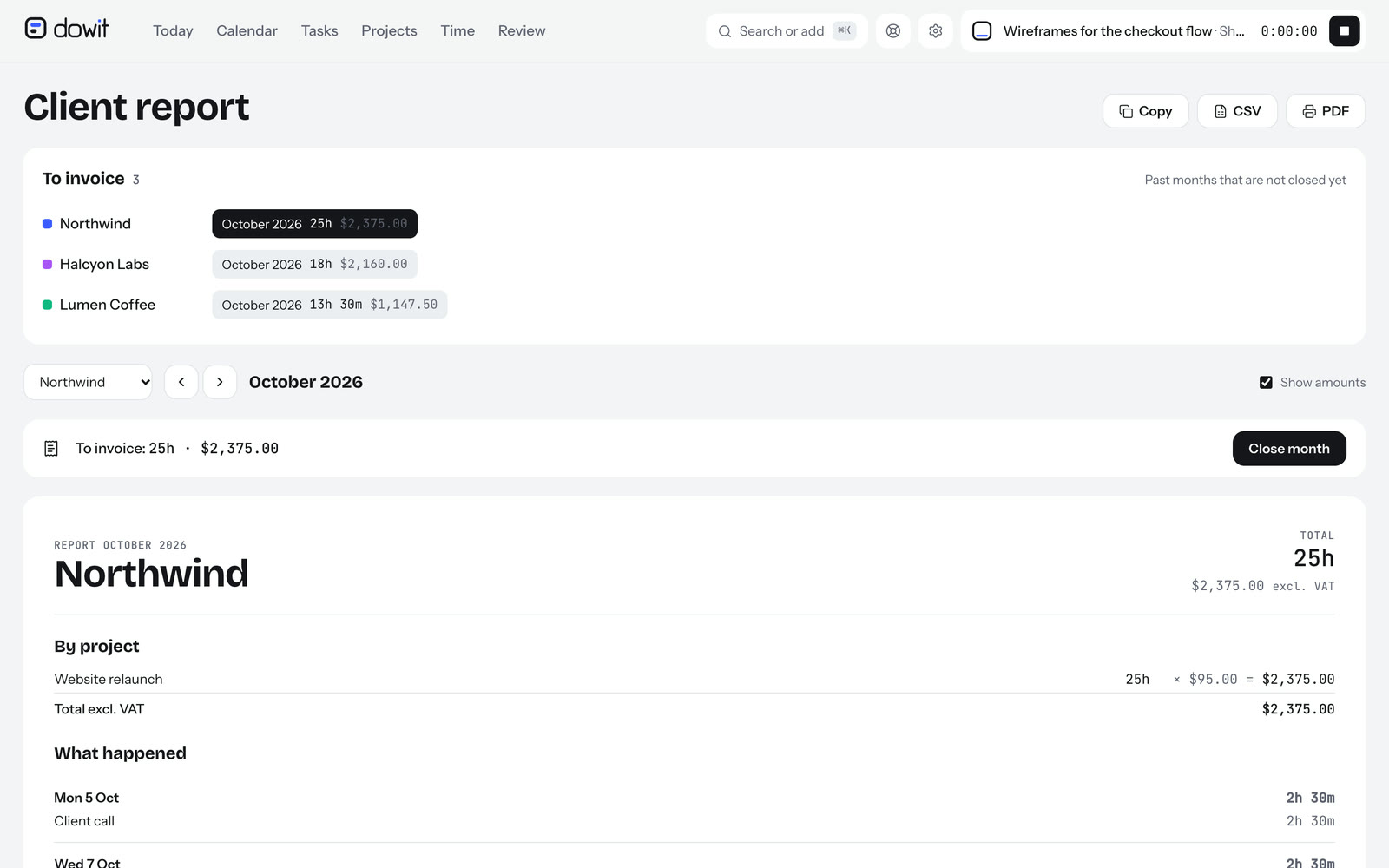
- A monthly client report: hours per project, what you did each day and the amount excluding tax, ready to copy as text, PDF or CSV.
- "What do I still need to invoice?": a list of past months that are still open, per client.
Your time overview also helps you fine-tune your rate: compare your billable hours with your total working hours and you'll see your real billable share. Dowit doesn't create invoices; you make those in your own invoicing tool using the amounts from the report. Tracking your hours in Dowit is free; client reports with amounts are part of Pro. See pricing.
Frequently asked questions
What is a good hourly rate for a freelancer?
It depends on your field, your experience, your country and your costs. Start by working out your minimum with (income + costs) ÷ billable hours, then compare it with what's typical in your field. Your rate should at least cover that minimum.
How many billable hours a year is realistic?
It varies from person to person, but many freelancers bill roughly 50–65% of their working hours. With 45 working weeks of 40 hours and a 60% billable share, that's 1,080 hours a year. Measure your own figure by tracking all your hours for a few months, including the non-billable ones.
Do I need to account for tax and social contributions?
Yes, indirectly: the calculator asks for your target income before tax. How much of that goes on tax and social contributions varies widely by country and circumstances. Ask your accountant to work out the pre-tax figure you need.
How do I turn my hourly rate into a day rate?
Multiply your hourly rate by 8. At $64.81 an hour that's about $519 a day. If your days on site are shorter or longer, adjust the number of hours and agree with the client what a "day" means.
Why is my calculated rate higher than I expected?
Usually because you can only bill part of your hours, and you cover your own costs, holidays and sick days. 1,080 billable hours is only about half of 52 full-time weeks. That's normal, and it's exactly why a freelance rate sits above a salary converted to an hourly figure.
Does Dowit create invoices?
No. Dowit tracks your hours and your rates per client or project and produces a monthly report with amounts for each client. You take that to your own invoicing tool as text, PDF or CSV, and create and send the invoice there.